Deliberate Practice Plan: What It Is and How to Build One
You've probably noticed that practicing more doesn't always mean improving more. You run scales, repeat a passage, or drill a technique for an hour and still feel stuck at the same level three months later. That's usually a sign you're practicing without a plan, not a skill problem. A deliberate practice plan fixes this by turning vague repetition into a structured process built around specific goals, targeted exercises, and honest feedback.
If you're searching for examples of deliberate practice plan structures, here's the short answer: a solid plan breaks a broad skill into narrow, measurable tasks, schedules them at intervals that match how fast you actually forget, and uses your own performance to decide what comes next. It's not a rigid worksheet, it's a feedback loop.
In this article, you'll get a clear definition of deliberate practice, see real examples of plans for musicians and other skill learners, and walk through how to build your own step by step, including how to structure sessions, set benchmarks, and track progress without drowning in spreadsheets.
Why a deliberate practice plan speeds up skill growth
Most people confuse practice with rehearsal. Rehearsal is running through what you already know; deliberate practice is targeting exactly what you don't know yet, at the edge of your current ability, with feedback that tells you if you're improving. Psychologist Anders Ericsson's research on expert performance found that raw hours matter far less than how those hours are structured. Musicians who logged the same practice time showed wildly different skill gains depending on whether their sessions had specific goals and immediate feedback loops. That's the entire case for a plan: it converts unfocused hours into hours that actually change your ability.
Random practice wastes your best hours
Without a plan, you default to practicing what's already comfortable, because comfortable feels productive. You'll play the passage you've nailed twenty times instead of the four measures that keep tripping you up. A structured plan forces you to confront the weak spot directly with techniques that isolate a single weakness, which is uncomfortable but is where the actual growth happens. This is why two people can log identical practice hours and end up at different skill levels after a year.
Practicing what you're already good at feels productive, but it's the four measures you keep avoiding that actually move your skill forward.
The forgetting curve makes timing matter as much as effort
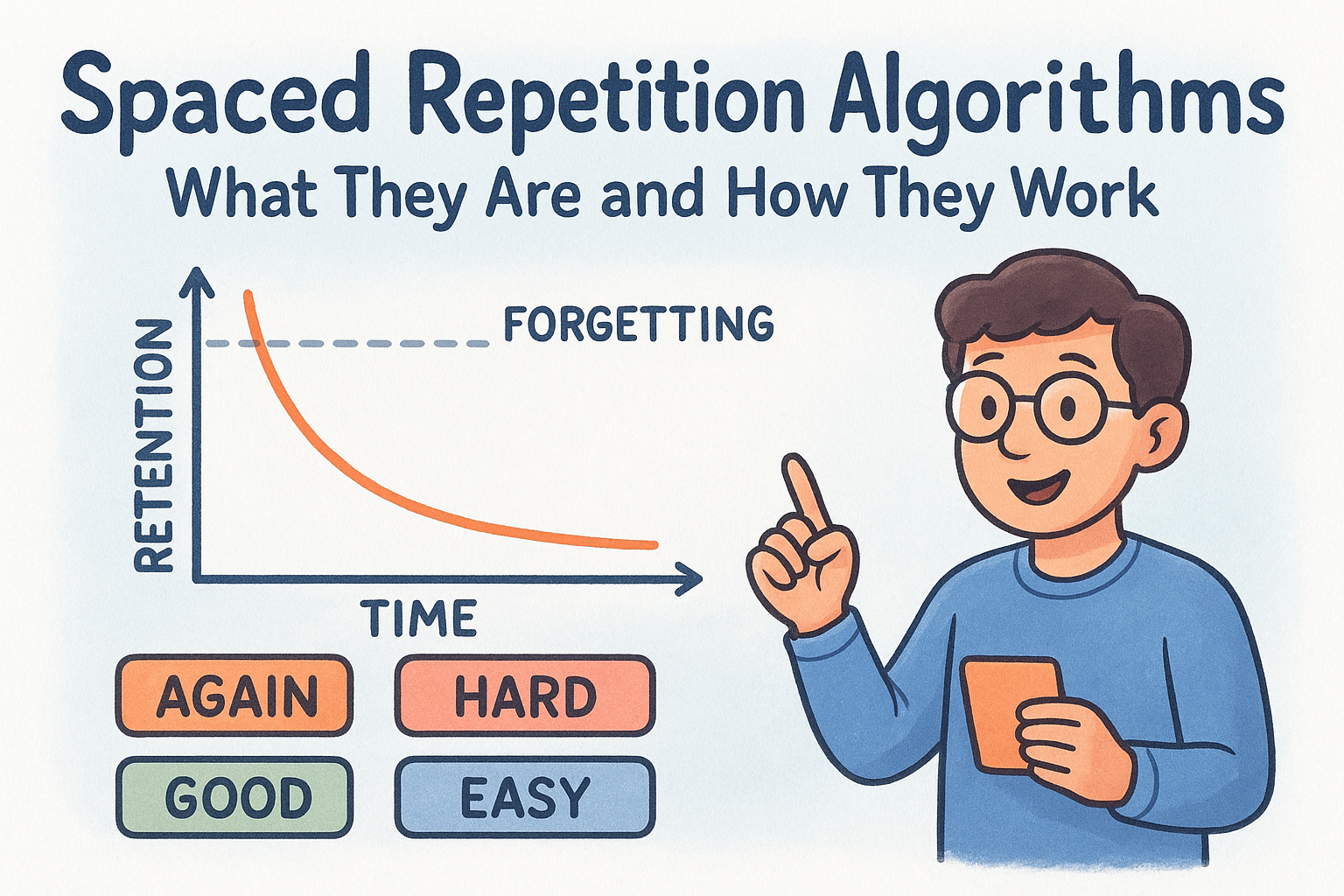
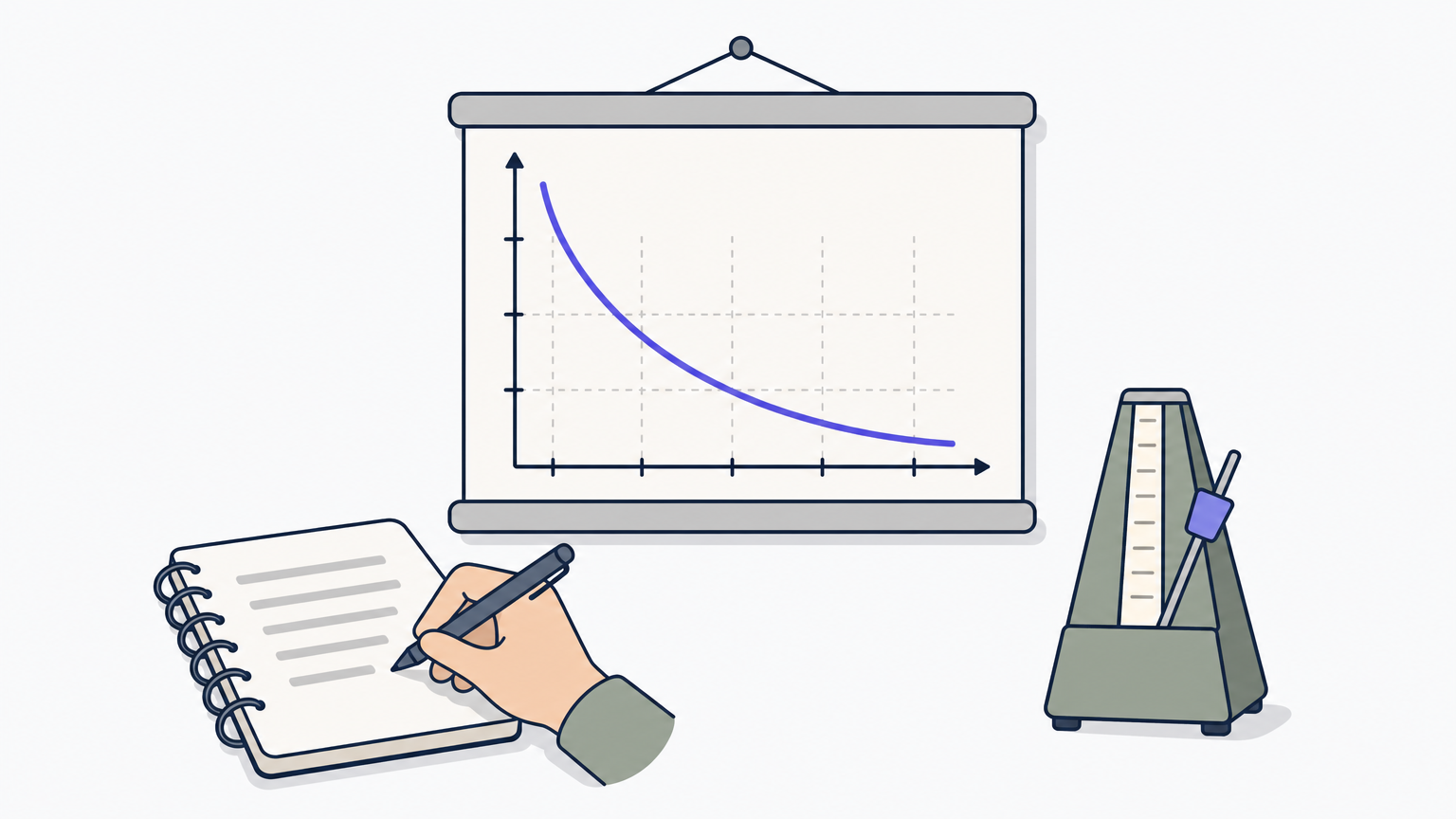
Hermann Ebbinghaus documented over a century ago that memory and skill retention decay on a predictable curve. You forget fastest right after learning something, then the decay slows the more times you successfully recall it. This means when you practice matters almost as much as what you practice. Drill a skill too often and you waste time on something already solid. Wait too long and you're relearning from scratch instead of reinforcing. A deliberate practice plan uses this curve to schedule review at the point where the skill is about to fade, not before and not after, which is exactly what spaced repetition does to your review timing.
Feedback closes the loop that unstructured practice skips
Growth requires knowing whether last week's practice actually worked, and feedback is one of the key components of deliberate practice in psychology. Skill practitioners who rate their own performance (something as simple as marking a drill "still hard" or "getting easy") give their plan the data it needs to adjust automatically. Without that feedback signal, you're guessing at what to revisit, and guessing is exactly what a deliberate practice plan is designed to eliminate.
Here's a quick comparison of what changes when structure and feedback enter the picture:
| Approach | What you practice | When you practice it | Result over time |
|---|---|---|---|
| Unstructured practice | Whatever feels familiar | Whenever you remember | Plateaus, rusty skills |
| Deliberate practice plan | Specific weak points | Scheduled at forgetting-curve intervals | Steady, measurable gains |
Once you see practice this way, the appeal of automating it becomes obvious. Scheduling forty exercises across a dozen skills by memory is unrealistic for anyone with a job, a family, or more than one instrument. Tools like MemoRep exist specifically to run this scheduling logic for you, using the same spaced repetition math that shows up in the research, so you spend your practice time actually practicing instead of deciding what to practice next.
How to build a deliberate practice plan step by step
Building a deliberate practice plan and running a deliberate practice session doesn't require a coaching certificate or a color-coded spreadsheet. It comes down to five decisions you make once, then adjust as your skill improves.
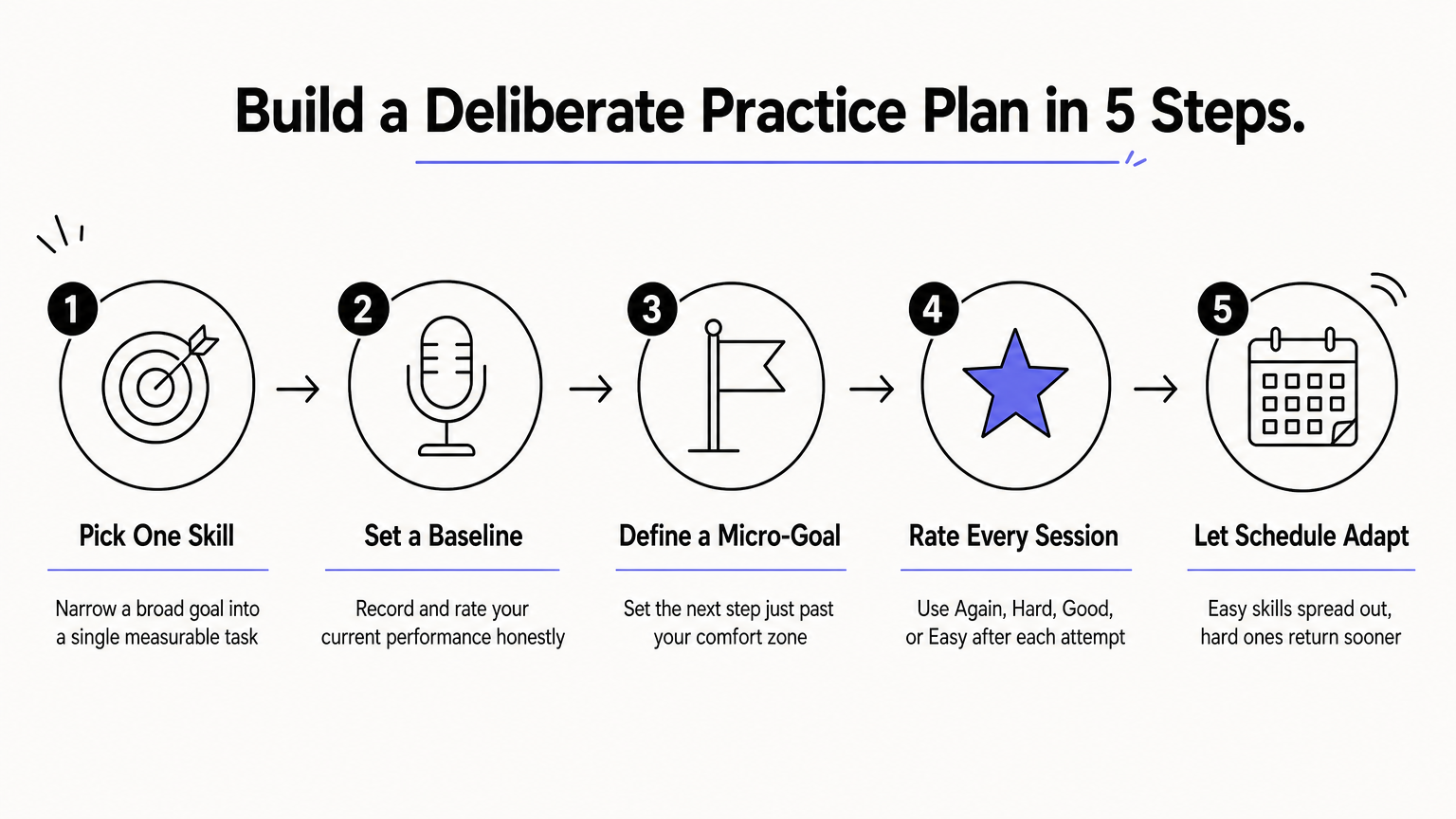
- Pick one narrow skill, not a broad category. "Improve jazz comping" is too vague; "play the ii-V-I voicing in four keys without looking at the chart" is a task you can actually schedule and grade.
- Set a baseline before you touch a metronome. Record yourself once, honestly rate the result, and write down what specifically failed in a practice journal template: timing, accuracy, memory, tone.
- Define the next micro-goal, sitting just past your current comfort zone. If you can play a passage at 80 BPM cleanly, the goal is 90 BPM, not 140.
- Build in a feedback rating for every session. A simple Again, Hard, Good, Easy scale forces you to log whether the drill actually got easier, which is the data your plan needs to reschedule anything correctly.
- Let the schedule adapt, instead of fixing every drill to "every Monday." Skills you rate Easy should drift further apart; anything rated Again should come back within a day or two.
A plan without a feedback rating is just a to-do list that never learns from you.
Once those five pieces exist, the mechanical part, deciding what to open your practice session with tomorrow, stops being your job. That's the piece most self-made plans skip: they define the tasks but never build the review logic that keeps them adaptive. Creating practice cards for each micro-goal inside a system like MemoRep handles that scheduling automatically, using the same interval logic described above, so the plan keeps working even on weeks when you don't have time to sit down and re-plan it yourself.
Deliberate practice plan examples for real skills
Seeing a deliberate practice plan applied to a real skill makes the concept click faster than any definition. Below are three sample structures you can adapt directly, whether you're a musician, a teacher building plans for students, or working on a physical skill outside of music.
A guitarist working on jazz improvisation
Say your weak point is soloing over ii-V-I changes without falling back on the same three licks. The micro-goal becomes "play a four-bar solo over ii-V-I in three keys using only chord tones." You'd log a session every other day, rate each attempt Again, Hard, Good, or Easy, and let intervals stretch once a key stops feeling shaky, which is the core of how to practice guitar efficiently. This is a textbook case of examples of deliberate practice plan structures: one narrow task, a clear pass/fail signal, and a schedule that reacts to your own ratings instead of a fixed calendar.
A good example plan has exactly one moving target per card, not a bundle of loosely related goals.
A music teacher building plans for students
Teachers juggling ten students and forty exercises benefit most from breaking each lesson goal into its own card rather than one giant "practice sheet." A beginner violin student might get separate cards for bow hold, first-position intonation on the D string, and quarter-note rhythm reading. Grading each card independently after every lesson shows exactly which skill is decaying and which one is solid, instead of a vague "keep practicing" note that tells the student nothing.
A non-musical skill: public speaking
Deliberate practice isn't limited to instruments. A public speaker working on filler words might set the micro-goal "deliver a two-minute pitch with zero verbal fillers," record it, rate the attempt, and reschedule based on how clean the recording sounded. The same logic applies to coding drills, sports footwork, or woodworking joints: narrow task, honest rating, adaptive spacing.

| Skill area | Micro-goal example | Rating trigger |
|---|---|---|
| Guitar improv | Solo over ii-V-I with chord tones only | Clean run = Easy, hesitation = Hard |
| Violin lesson | D-string intonation, five reps in tune | Any pitch drift = Again |
| Public speaking | Two-minute pitch, zero fillers | One filler word = Hard |
Common mistakes that stall a deliberate practice plan
Even a solid deliberate practice plan can grind to a halt if you fall into a few predictable traps. Most of these mistakes aren't about laziness, they're about the plan quietly drifting away from the feedback loop that made it work in the first place.
Skipping the honest baseline
Jumping straight into drills without recording where you actually stand is the fastest way to derail a plan. You end up guessing at progress instead of measuring it, which means your micro-goals stay vague and your ratings become meaningless. Take five minutes to record a baseline attempt before you touch the schedule. Without it, you have no reference point to know if next month's version of you is actually better.
Grading yourself too generously
Rating every attempt "Good" or "Easy" because it feels encouraging defeats the entire point of the feedback rating system. If a passage still wobbles at speed but you mark it Easy anyway, the schedule pushes it further out right when it needs more attention. Be blunt with yourself. A rating that flatters your ego just delays the plateau, it doesn't prevent it.
A dishonest rating doesn't protect your motivation, it just postpones the plateau.
Overloading the schedule with too many skills at once
Stacking fifteen new micro-goals into a single week guarantees you'll rush through half of them without real feedback, which quietly breaks the whole system. Keep the active list short enough that every card gets a genuine attempt and an honest rating.
A quick checklist to catch these before they stall your progress:
- Recorded a real baseline before starting, not just a guess
- Rated the last three sessions honestly, not optimistically
- Limited active cards to what you can genuinely attend to each week
- Checked whether any card has sat untouched for weeks without a rating
Ignore any one of these and the plan stops adapting. It turns back into the same unstructured routine you were trying to escape, just with extra paperwork attached.
Making deliberate practice part of your routine
A deliberate practice plan only works if it keeps running after the initial motivation fades. Narrow goals, honest ratings, and adaptive scheduling are the three pieces that make growth measurable instead of accidental. Skip any one of them and you're back to the same unstructured practice that got you stuck in the first place.
Building this by hand with spreadsheets and calendar reminders is doable, but it's also where most plans quietly fall apart, usually around week three. Nobody wants another admin task competing with actual practice time. That's the exact gap MemoRep fills: create a practice card for each micro-goal, rate your sessions Again, Hard, Good, or Easy, and let the scheduling logic handle the rest.
If you want to see the algorithm behind that scheduling before committing to anything, see the spaced repetition science that powers MemoRep's practice scheduling and start building a plan that actually adapts to you.